 English
  Chinese
  Japanese
  German
  Korean
  French
  Portuguese
  Spanish
  Russian
  Arabic
  Greek
Greek  Turkish
  Italian
  Danish
  Romanian
  Indonesian
  Czech
Czech  Afrikaans
  Swedish
  Polish
  Basque
  Catalan
  Esperanto
  Hindi
Hindi  Lao
Lao  Albanian
  Amharic
  Armenian
  Azerbaijani
  Belarusian
  Bengali
  Bosnian
  Bulgarian
  Cebuano
  Croatian
  Dutch
Dutch  Estonian
  Tagalog
  Finnish
  Galician
  Georgian
  Gujarati
  Hebrew
  Hungarian
  Icelandic
  Javanese
  Kannada
  Kazakh
  Khmer
Khmer  Kyrgyz
  Latvian
  Lithuanian
  Macedonian
  Malay
Malay  Malayalam
  Marathi
  Mongolian
  Myanmar
  Nepali
  Norwegian
  Pashto
  Persian
  Panjabi
  Serbian
  Sinhala
  Slovak
  Slovenian
  Scottish Gaelic
  Sindhi
  Swahili
  Tamil
Tamil  Telugu
  Thai
Thai  Ukrainian
  Urdu
Urdu  Uzbek
Uzbek  Vietnamese
  Welsh
Welsh  Tatar
Tatar  Uighur


Choosing Packaging Equipment isn’t usually a matter of finding available machines. The harder decision is identifying the setup that fits your product, package format, speed targets, accuracy requirements, and staffing realities. From there, the right choice comes down to a practical balance. What are you packing, how fast does the line need to run, and how much automation can your facility support?
Understanding Packaging Equipment
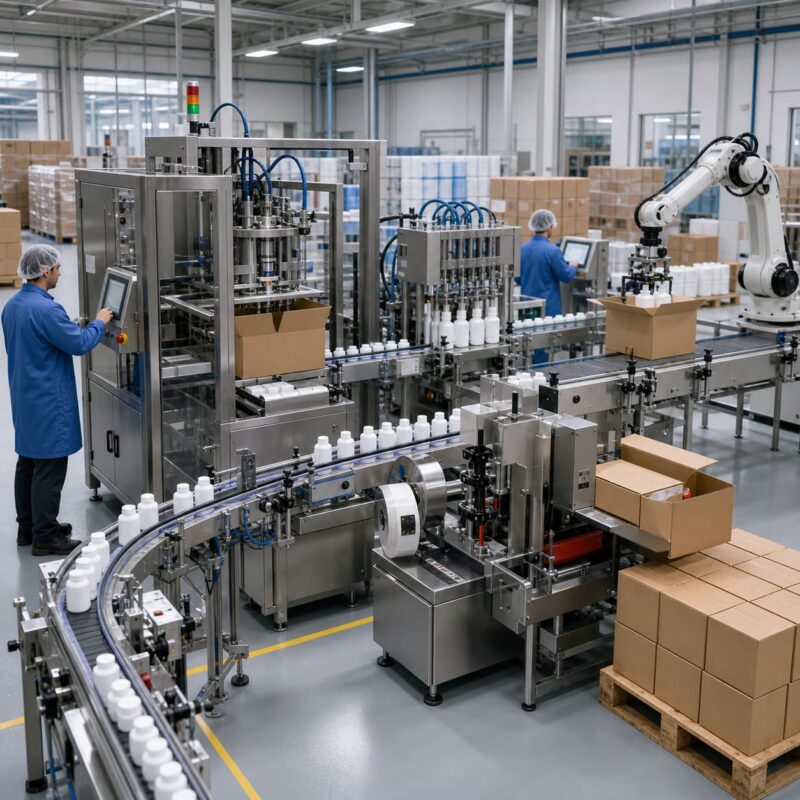
Illustration for Understanding Packaging Equipment
Understanding Packaging Equipment starts with a sharper buying question: which machine fits your product, package format, target speed, and available labor? That frame narrows the field faster than a generic equipment list and keeps supplier conversations tied to production reality.
- Match the product to the fill method first Best for: powders, granules, liquids, and fragile solids.
Machine families: weigh-fill systems, volumetric fillers, auger fillers, and piston fillers. Pros
Screens out poor-fit machines early Connects machine choice to accuracy, waste, and cleanup Separates semi-automatic from fully automatic options sooner
Cons
Viscosity, fragility, and dust behavior can be missed Poor fill-method selection can increase giveaway and downtime
Decision logic: Product behavior should lead the fill decision, ahead of brand or machine style. Snack mixes with weight-sensitive ingredients usually point to multihead weighers. Free-flowing rice or beans may work with volumetric filling when slight variation is acceptable. If your spec allows ±2–3% fill variance, volumetric filling may reduce capex. For tighter control on a higher-value product, weigh-fill can earn back the premium through lower giveaway. 2. Choose the package format next Best for: bags, pouches, trays, bottles, and cartons.
Machine families: VFFS, premade pouch machines, and tray sealers. Pros
Narrows the machine family quickly Clarifies tooling, film, and changeover needs Exposes format-driven labor costs
Cons
Format upgrades can raise material cost Throughput can vary by format
Decision logic: Once the fill method is clear, package format determines the core machine family. A pillow bag usually points to VFFS. A stand-up zipper pouch often points to a premade pouch machine. Ready meals usually need a tray sealer. PMMI regularly reports labor and workforce pressure across packaging operations, so format choice should account for labor as well as shelf appeal. For frequent SKU changes, ask for documented changeover time and tooling cost before comparing quotes. 3. Set throughput, automation, and line stage together Best for: plants balancing labor shortages, floor space, and growth.
Machine families: semi-automatic fillers, fully automatic baggers, secondary packers, and end-of-line systems. Pros
Keeps spending aligned with usable speed Links packaging speed to upstream and downstream constraints Makes integration gaps visible early
Cons
Fast primary packaging can bottleneck at cartoning or palletizing Small footprints can limit future automation
Decision logic: After fill and format, size the line around usable throughput. Many equipment overviews group primary packaging, secondary packaging, end-of-line, and protective packaging together. Buyers should separate those stages before sourcing. A machine is only as useful as the line around it. If your target is 40 packs per minute and hand case packing tops out at 20, the bottleneck is the case-packing step, not the bagger.
Next action: Build a one-page RFQ with six fields: product, package style, target speed, fill accuracy, changeover frequency, and available labor. Then ask suppliers for three items: recommended machine family, expected throughput on your product, and a budget range that includes tooling, lead time, spare parts, and FAT terms.
Conclusion
Use this list of Packaging Equipment options to pinpoint your current bottleneck. Then narrow your choices by format, speed, footprint, and automation level before you speak with suppliers or request quotes.